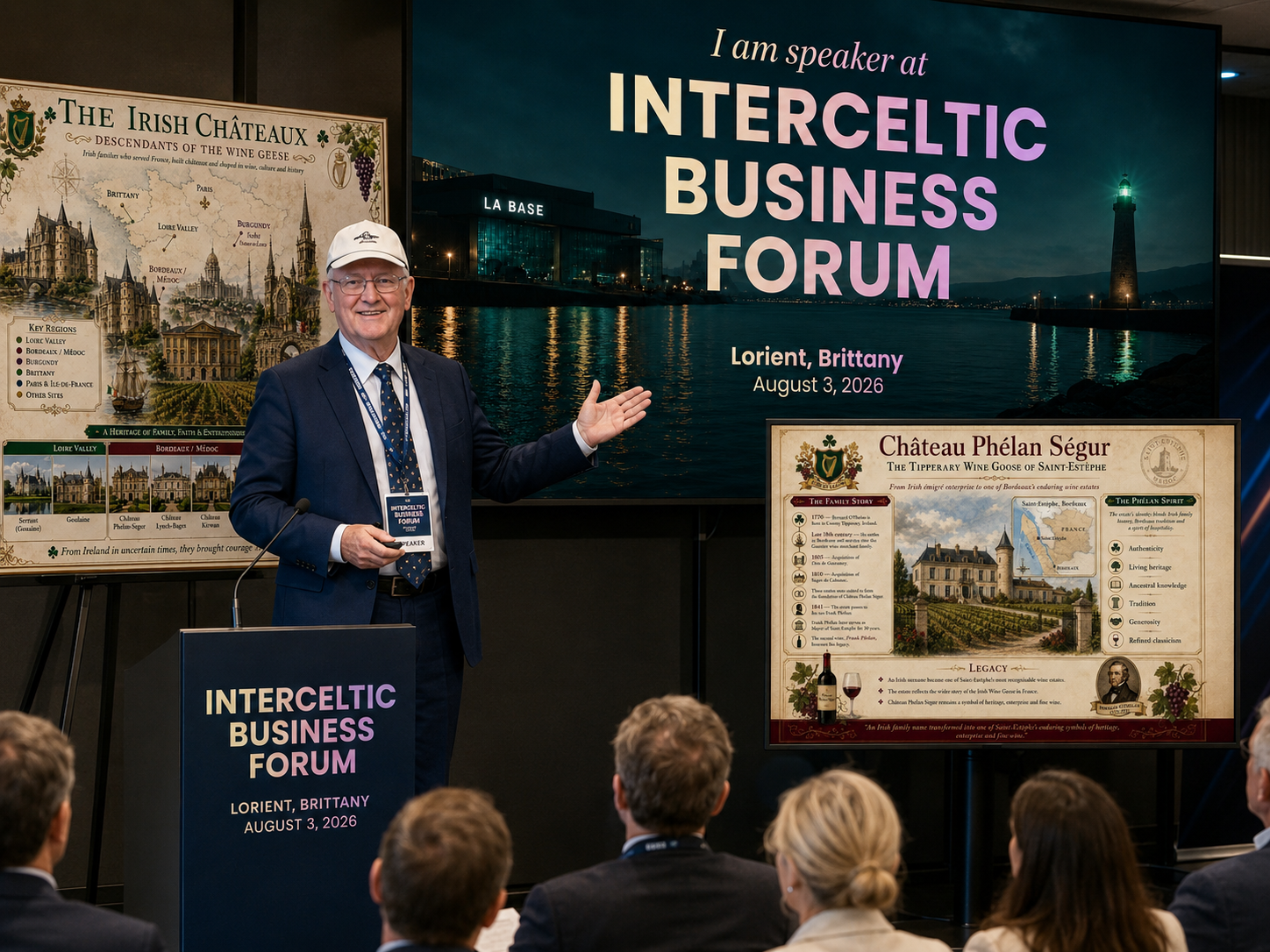
A pictorial history of the remarkable influence of Irish families and Irish châteaux on the French wine industry
At the 10th Interceltic Business Forum in Lorient, I began my presentation with a deliberately
provocative variation on Jane Austen:
“It is a truth universally acknowledged that the finest wine in the world comes from France; that the finest wine in France comes from Bordeaux; and that some of the finest wine in Bordeaux comes from the Irish châteaux - the great vineyards founded by seventeenth- and eighteenth-century Irish exiles who became known as the Wine Geese.”
It was a light-hearted opening, but behind it lies an extraordinary story of exile, enterprise, resilience and the centuries-old relationship between Ireland and France. I would first like to thank Charles Kergaravat for the invitation to speak and to congratulate him, his team and the wider community on ten years of the Interceltic Business Forum. The Forum has become a place where Celtic regions meet not simply to celebrate shared identity, but to build practical elationships, exchange ideas and create new opportunities.
The Wine Geese story seemed especially appropriate for that setting. Three centuries before anyone used the language of international networks, regional ecosystems or cross-border innovation, Irish emigrants were already building precisely those things across France.
The story begins with the Wild Geese. Following the wars of the seventeenth century and, mostfamously, the Treaty of Limerick in 1691, thousands of Irish soldiers and their families left Ireland for continental Europe. France became one of their most important destinations. Irish migrants entered the French military, the Church, education, administration and commerce; some rose to the highest levels of French society.
Out of this wider diaspora emerged a remarkable commercial tradition. Irish merchants established themselves in Atlantic ports such as Bordeaux, where they became traders, négociants, vineyard owners and château proprietors. Over time, the military Wild Geese acquired a commercial cousin: the Wine Geese. The term was popularised by Cork historian Ted Murphy, whose research brought together the scattered stories of Irish families involved in wine around the world.
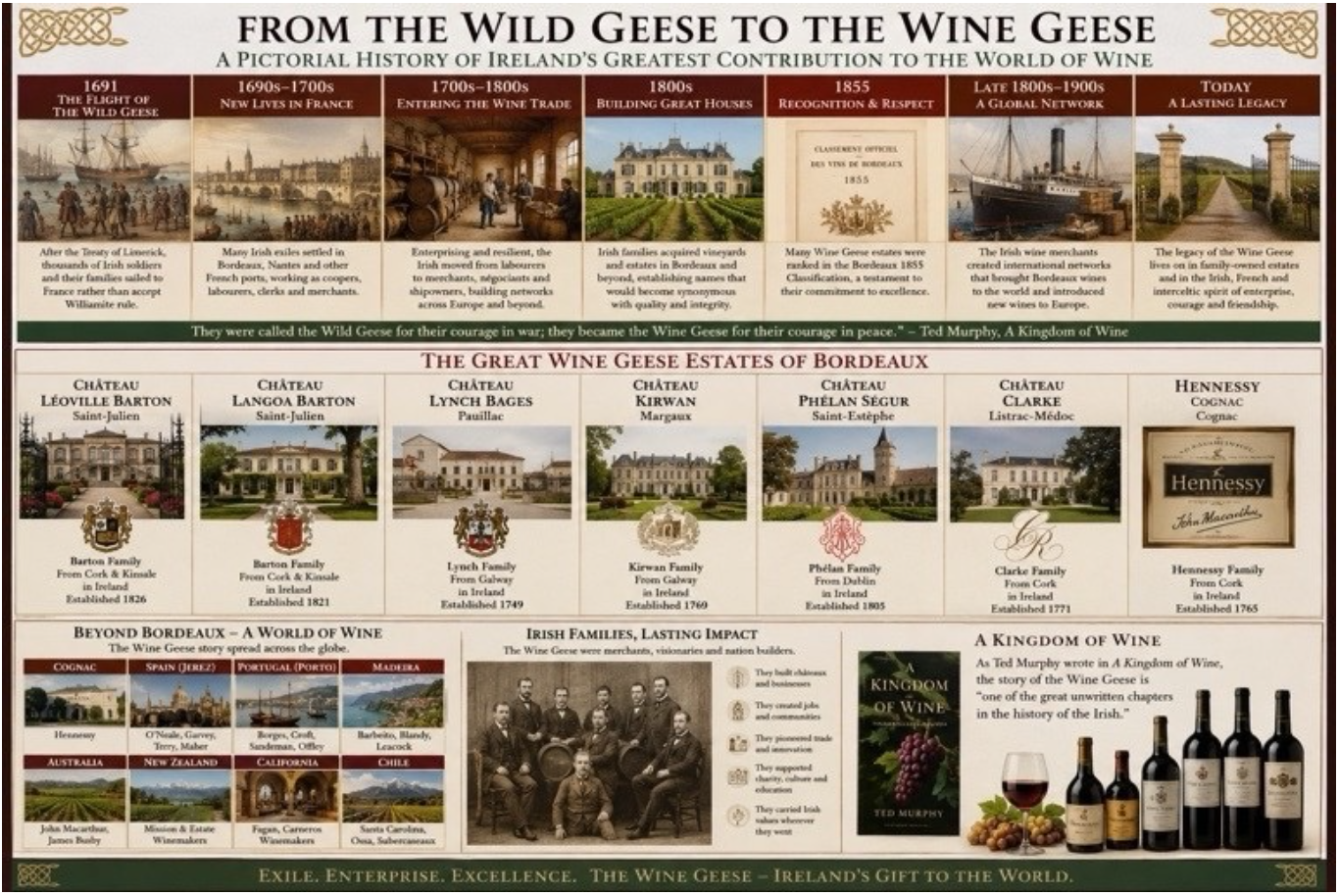
Walk through the Médoc today and the Irish connection is visible on some of Bordeaux’s best-known labels. Barton, Lynch, Kirwan and Phélan are not historical footnotes: they remain part of the living geography of fine wine. Thomas Barton left Ireland in the early eighteenth century and established himself in the Bordeaux trade. Later generations acquired Langoa and part of the great Léoville estate, creating Château Langoa Barton and Château Léoville Barton. The Lynch family, originally from Galway, became associated with the estate that became Château Lynch-Bages. Mark Kirwan, also from a Galway merchant family, gave his name to Château Kirwan in Margaux. Bernard O’Phelan, born in County Tipperary in 1770, settled in Bordeaux, married into the Guestier wine-merchant family and assembled the properties that became Château Phélan Ségur.
These families did more than buy vineyards. They built trading relationships, understood international markets, married into established French commercial families, reinvested in land and created dynasties. Their success is a striking early example of the combination of local rootedness and international reach that modern regional economies still seek to achieve.
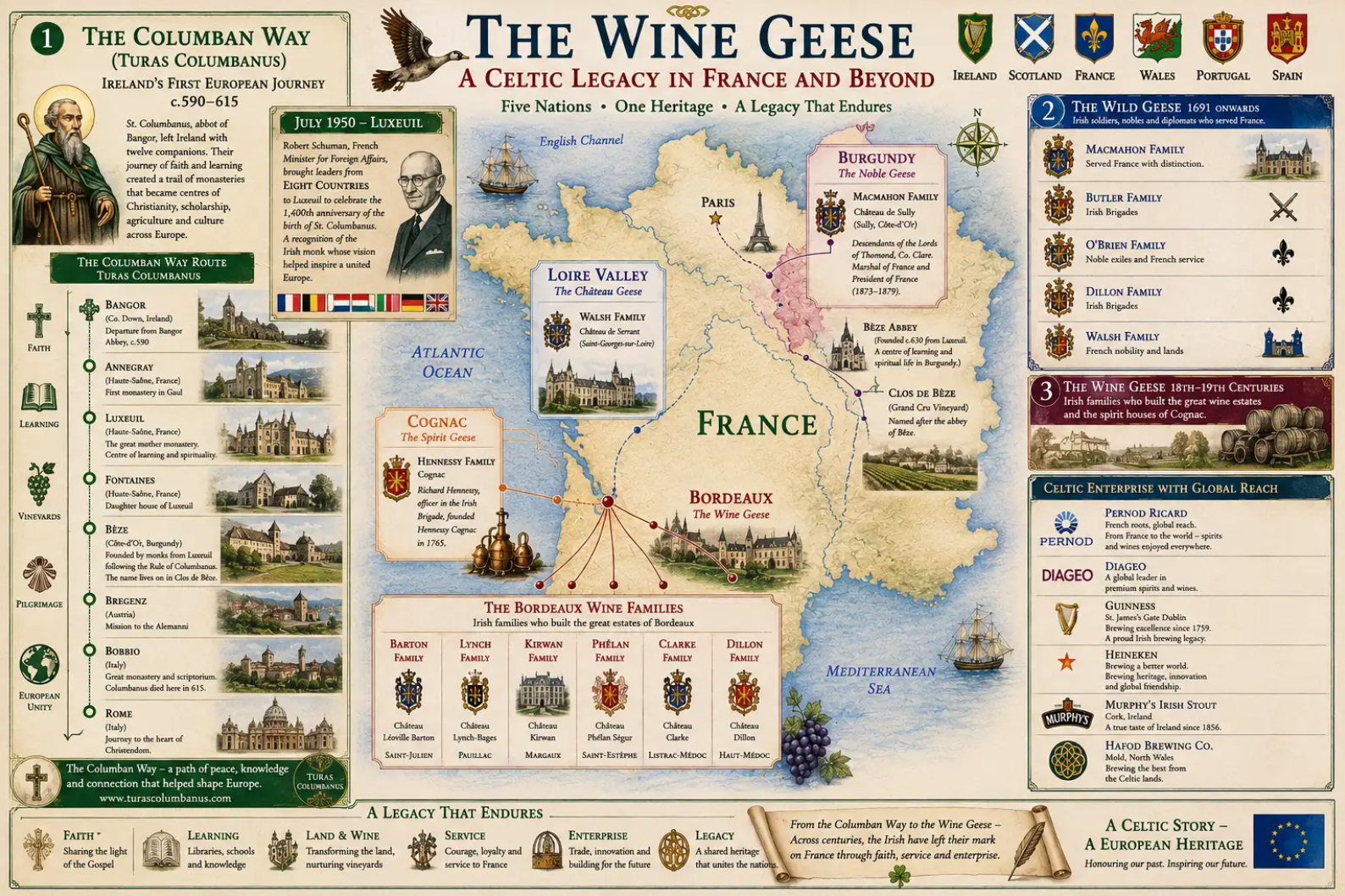
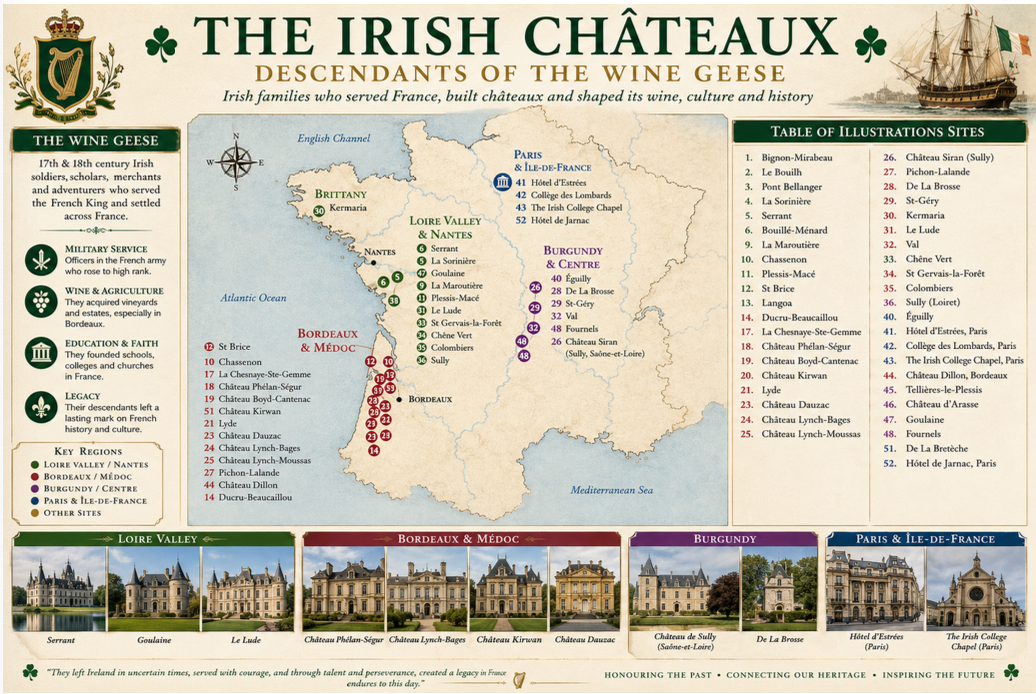
Bordeaux is the best-known chapter, but it is only part of the story. Renagh Holohan’s The Irish Châteaux: In Search of Descendants of the Wild Geese follows Irish families through a remarkable collection of houses, estates and institutions across France. Using her map and Table of Illustrations as a starting point, I began plotting these sites: Brittany, the Loire Valley, Paris, Bordeaux and the Médoc, Burgundy and central France.
The result changes the way we see the diaspora. Instead of thinking of the Wild Geese simply as a departing army, we can see a network of families embedding themselves into French life over generations. The physical evidence survives in châteaux such as Serrant, Goulaine, Le Lude and Sully; in great Bordeaux estates including Phélan Ségur, Lynch-Bages, Kirwan and others; and in Irish institutions in Paris such as the Collège des Lombards and the Irish College.
The map is therefore more than a travel guide. It is a visual record of how Irish identity, family networks and enterprise became part of the landscape of France. It also suggests a modern opportunity: a Franco-Irish heritage route linking châteaux, vineyards, ports, colleges and family stories. Such a route could bring together cultural tourism, genealogy and wine tourism while giving visitors a more human way to understand the long relationship between the two countries. Interceltic Business Forum -
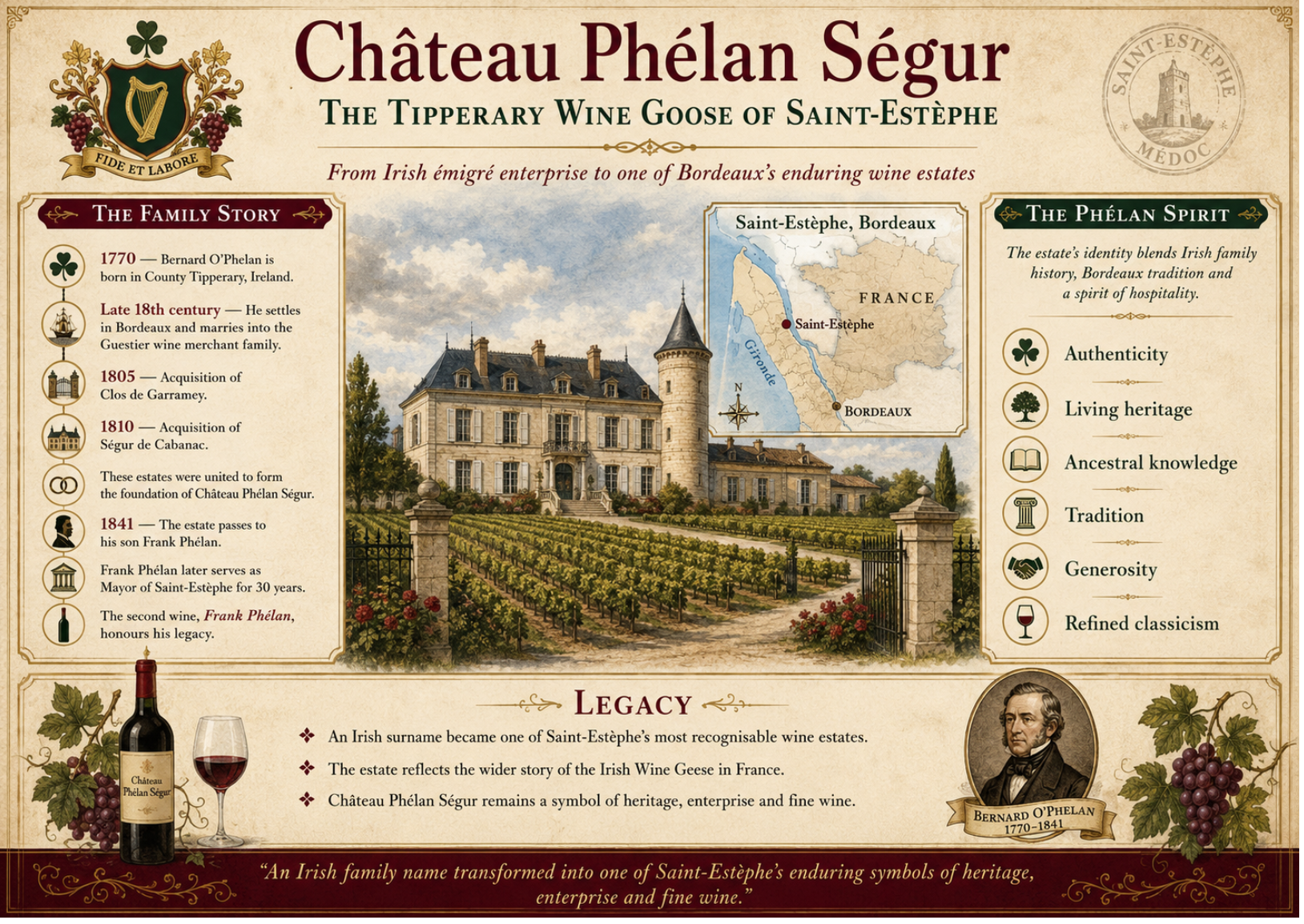
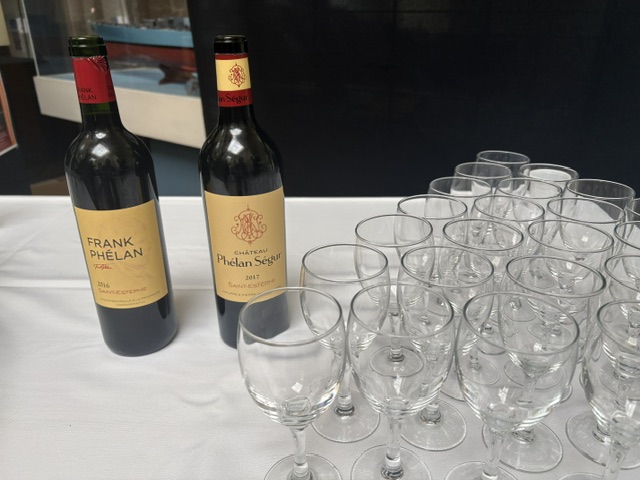
The Phélan story is one of the clearest examples of this transformation. Bernard O’Phelan was born in Tipperary in 1770. He moved to Bordeaux at the end of the eighteenth century and became connected by marriage to the Guestier wine family. He acquired Clos de Garramey in 1805 and Ségur de Cabanac in 1810, creating the foundations of the estate that became Château Phélan Ségur.
His son Frank Phélan continued the family story and served as mayor of Saint-Estèphe for manyyears. Today the name survives not only on the château but also in the estate’s second wine, Frank Phélan. It is a wonderful example of an Irish surname becoming inseparable from the identity of one of the great wine villages of the Médoc.
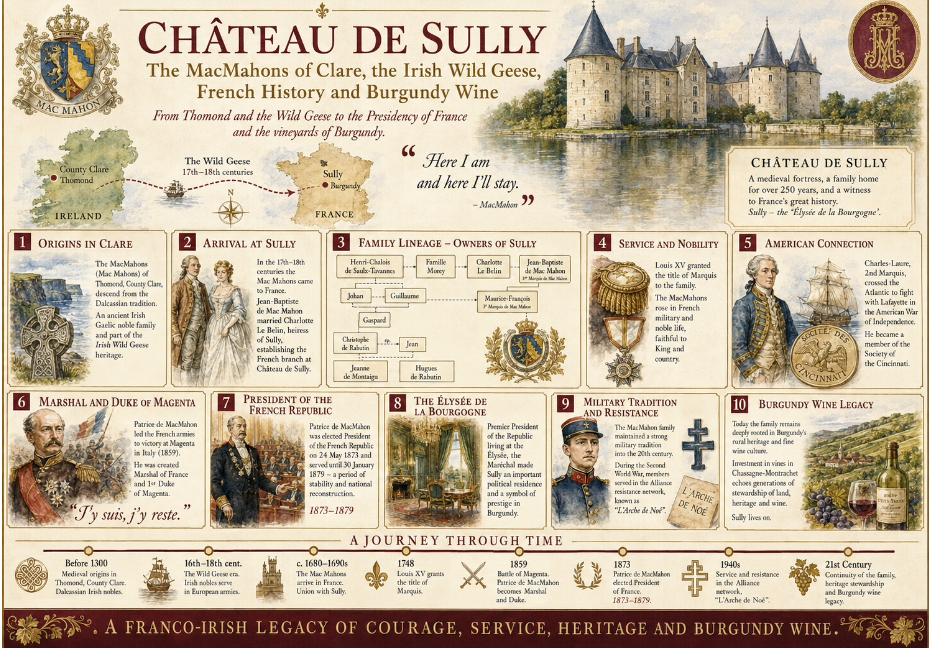
The MacMahon story reminds us that the Irish châteaux are not exclusively a wine story. Château de Sully in Burgundy became the French seat of the MacMahon family. The family’s French trajectory culminated spectacularly in Patrice de MacMahon - soldier, Marshal of France, Duke of Magenta and President of the French Republic from 1873 to 1879. Noel MacMahon’s Here I Am, Here I Stay! Marshal MacMahon 1808-1893, edited after Germain Bapst, brings this figure into the story. His famous phrase, “J’y suis, j’y reste” - “Here I am, here I stay” - is an apt description of the wider Irish experience in France. The exiles did not remaintemporary outsiders. Their descendants became landowners, officers, politicians, merchants andcultural figures, deeply integrated into French society while retaining a memory of Irish origins.
Sully also matters geographically. It is in Burgundy, in Saône-et-Loire, not to be confused withSully-sur-Loire. Placing it correctly on the map helps show just how widely the Irish presenceextended across France.
Three books provided the intellectual and visual backbone for this pictorial journey. Each contributes a different part of the story.
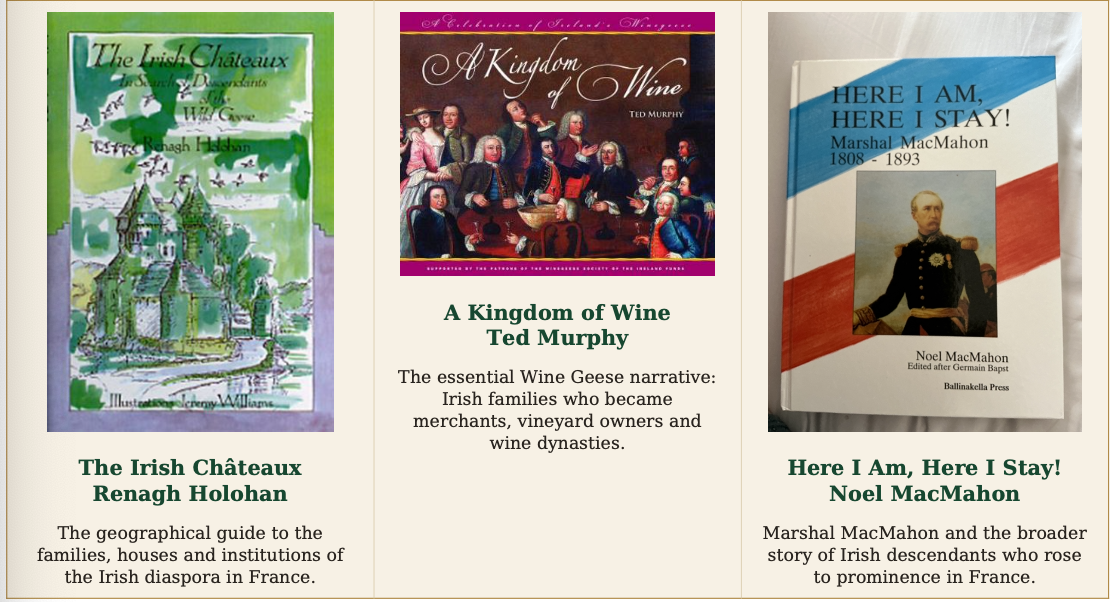
Renagh Holohan gives the presentation its map and its breadth. Her book demonstrates that theIrish presence can be read in stone, architecture and place names across France. Ted Murphy gives us the Wine Geese as a coherent historical idea, connecting Irish migration with the international wine trade. Noel MacMahon adds the MacMahon dimension, reminding us that the diaspora’s impact included the military and political life of France as well as commerce and wine.
Renagh Holohan — The Irish Châteaux: In Search of Descendants of the Wild Geese
Ted Murphy — A Kingdom of Wine: A Celebration of Ireland’s Wine Geese
Noel MacMahon — Here I Am, Here I Stay! Marshal MacMahon 1808–1893, edited after Germain Bapst, Ballinakella Press.
The most interesting part of the Wine Geese story is not nostalgia. It is the continuing relevance of the model. These families succeeded because they built relationships across cultures. They combined local knowledge with international networks. They adapted, married, invested and stayed for the long term. They were simultaneously Irish and deeply engaged in the life of their adopted country.
That is why the story belongs at an Interceltic Business Forum. The Celtic regions are small by global standards, but they possess strong identities, international diasporas and networks that reach far beyond their borders. Collaboration can turn those networks into opportunities in tourism, food and wine, technology, research, culture and investment. The Wine Geese show that this is not a new idea. It is something our predecessors were doing three hundred years ago.
There is another lesson too. The strongest cross-border relationships are rarely created by a single transaction. They are built over time through trust, repeated contact and a willingness to become part of another community. The Irish families of Bordeaux understood this instinctively. Their story is therefore as much about relationship-building as it is about wine, and that is a message with obvious relevance for Celtic entrepreneurs seeking to collaborate internationally today.
The great Irish-linked estates of Bordeaux are not museums. They are living businesses producing wine today. The châteaux and institutions elsewhere in France are equally tangible reminders of a shared history. Together they offer the basis for a compelling Franco-Irish heritage trail - one that could connect wine tourism, genealogy, architecture, military history and the wider story of the Irish diaspora.
“The Wine Geese may have left Ireland, but Ireland never left them - and in the vineyards, châteaux and great wines of France, their legacy still speaks.”
Perhaps that is the most memorable lesson of all: exile became enterprise; enterprise became heritage; and heritage became something capable of surviving for centuries. From Wild Geese to Wine Geese, it is an extraordinary Irish contribution to France - and to the world of wine.
A particular thank you to Véronique Dausse and Château Phélan Ségur for generously supporting the presentation and providing bottles of Château Phélan Ségur 2017 and bottles of Frank Phélan 2016 for the Wine Geese tasting following the conference. Their generosity gave participants the opportunity not merely to hear the Phélan story, but to experience a living part of that Franco-Irish heritage.

Global Cornish comes together in Wisconsin and New York to help grow diaspora engagement.
Read More
Discover what makes the Isle of Man a unique place to do business, from innovation and collaboration to UNESCO Biosphere status and quality of life.
Read MoreA pictorial history of the remarkable influence of Irish families and Irish châteaux on the French wine industry
Read More%20(1).jpg)
Irish fintech recognised for transforming digital customer experiences with no-code innovation and AI
Read More


